
On January 6, 2021, the world watched as rioters breached security at the United States Capitol during the certification of the presidential election by a joint session of Congress.
The purpose of that session was to count and certify the Electoral College votes from the 2020 presidential election, a process established by law and grounded in the U.S. Constitution. While largely ceremonial, it remains a critical legal step in confirming the next President.
The sitting Vice President presides over this process. The President has no constitutional or statutory role in it.
As lawmakers carried out their duty, reading electoral votes state by state and addressing formal objections, rioters forced their way into the Capitol through doors and windows. They moved through offices, vandalised property, and confronted law enforcement officers. Proceedings were immediately halted. The House and Senate chambers were evacuated, and the Vice President, along with members of Congress, were taken to secure locations.
After several hours of disruption, order was restored. Congress reconvened later that evening and continued the certification process, working through the night until its completion in the early hours of January 7.
Two questions arise:
- Why was it necessary to complete the certification process? Because it was established by law.
- Why was it possible to complete the process, despite opposition from the President? Because there was a clear separation of duties, supported by strong institutions.
This is not a write-up about insurrection. It is about structure.
Every functioning community operates within a framework of rules and standards that guide behaviour, manage expectations, and enforce accountability. Organisations are no different.
Successful organisations, regardless of size, are built on clear structures, defined roles, aligned competencies, and effective performance frameworks. These elements create consistency, reinforce accountability, and enable capability. They reduce reliance on individuals and limit the need for reactive decision making.
When these structures are absent or poorly designed, the consequences are predictable: Decisions are inconsistent and accountability becomes blurred. Performance depends on individuals rather than systems. Over time, this leads to inefficiencies, internal friction, and avoidable risk.
There is no universal template for organisational structure. Structures are most effective when intentionally designed to reflect the organisation's purpose and strategic objectives.
Structure is not simply about hierarchy, departments, or reporting lines. It is an operational model that determines how work flows, how decisions are made, and how outcomes are delivered. When this model is unclear, even capable teams struggle to perform consistently, a hit and miss scenario.
Like any well-functioning system, the various units within an organisation must operate cohesively. Teams must collaborate, support one another, and understand what is expected of them, when it is required, and how their contributions fit into the broader system.
A structured organisation is one with a deliberate and coherent design, where people, processes, and resources are aligned to deliver outcomes efficiently and consistently.
The absence of structure does not create flexibility. It creates dependence on individuals, exposes the organisation to risk, and limits its ability to scale performance.
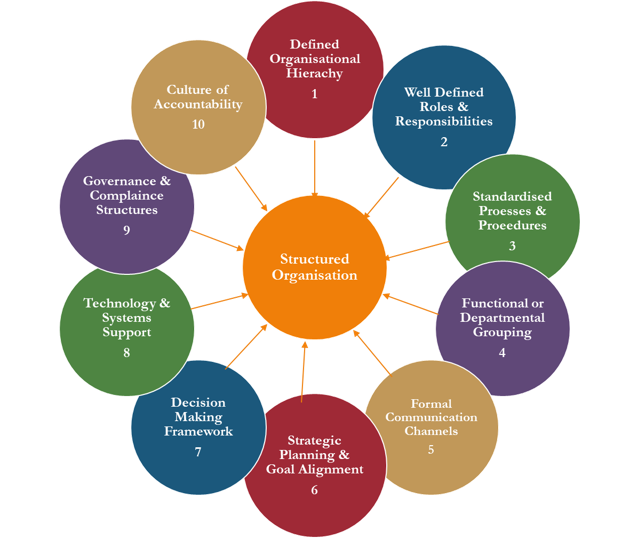
Key Elements of a Structured Organisation
Solid institutions do not happen by accident. They are deliberately built and sustained. The question is whether your organisation has been intentionally structured to deliver consistent performance.

Oluremi Ogundairo
Founder & Lead Consultant at InsightHabour. 15+ years helping organisations build high-performing teams.